

Here’s the thing about how to plan a corporate event: most are forgotten within a week. Not because the catering was bad or the venue was wrong, but because nobody thought hard enough about what the event was for and what would make the people in the room feel like it was worth their time.
After almost 15 years of corporate events across every industry and every scale from intimate team offsites to 3-day conferences abroad the pattern is consistent. The events people remember are not the most expensive ones. They are the ones where someone made a deliberate decision about what guests would feel, what they would take away, and what would make it distinctly theirs.
The short version: start with the outcome you want, not the format you think you need. Know your message before you know your room layout. Everything else AV, theming, entertainment, catering gets built around that. The events that engage employees are the ones where each person finds something to connect with personally, and leaves with one thing they will still remember next year.
How to Plan a Corporate Event: Start with the Outcome, Not the Logistics
When you’re working out how to plan a corporate event, the most common planning mistake is starting with the venue search. Before you know your message, your room layout means nothing. Before you know how you want guests to feel, a catering brief is just a catering brief.
Start with three questions:
- What do you want people to walk away believing?
- How do you want them to feel during the event?
- what is the one thing you want them to still remember twelve months from now?
Answer those first, and the rest of the planning becomes much more straightforward because every decision has a filter.
This is not about being abstract. It is practical. If you know the goal is to rebuild team morale after a difficult quarter, that tells you the tone, the activities, the content, and the pace. If you know the goal is to launch a new direction to the whole company, that tells you everything about how the AV needs to work and what the run of show should look like. The outcome defines the event, not the other way round.
The AV problem nobody talks about
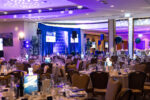
One of the most consistent engagement killers at corporate events is bad AV, usually justified as “keeping it simple.” A single projector at the front of a room with 300 people looks like a budget decision. In practice, it is an engagement decision and not a good one.
If the people at the back cannot read the slides, they cannot follow the speaker. If they cannot follow the speaker, they check their phones. If they check their phones, they are not there and by the next morning, neither is anything the speaker said. Visibility and sound are not production extras. They are the difference between content that lands and content that disappears.
Simplicity is a good instinct. Using it as a reason to under-invest in the one thing that determines whether your content reaches your audience is a different thing entirely. The right AV setup for your event does not have to be complicated. It just has to work for the room and the number of people in it.
Real engagement is personal not just participatory
There is a difference between an event where people are in the room and an event where people are engaged. The gap comes down to one thing: whether each person finds something that connects to them specifically.
Real engagement means every individual has a way to both take something away and give something back. They need to see how the content relates to their own role, their own team, their own situation. An event that speaks to the company as a whole but not to the individual in seat 47 has missed the point.
The practical version of this: involve guests before the event, not just on the day. Ask for input in advance. If there is something you want their perspective on, collect it ahead of time so you can build it into the content or the format. And think carefully about whether the entertainment and activities you have chosen give people a way to connect with each other not just stand near each other with a drink. Games work especially well here. They give people a reason to interact, a natural conversation starter, and something to be competitive about all without the social friction of a forced icebreaker.

Why drinks and canapés are not enough?
The “drinks and canapés” format has been the default corporate social for a long time. And it works up to a point. The problem is that as a conversation starter, it relies entirely on the guests doing the work. For confident, outgoing people who already know each other well, that is fine. For everyone else, it can feel like an obligation rather than an event.
More importantly, alcohol is no longer the social lubricant it once was. A growing proportion of employees either do not drink or are choosing not to, and an event built around the bar quietly excludes them from the best version of the night. A well-chosen mix of games, entertainment, and activities gives everyone a way in regardless of whether they are drinking.
This does not mean replacing the bar. It means not relying on it. A photo booth, a competitive game, a live act, or even a well-run team challenge gives guests a shared experience and a reason to talk which is what you wanted the drinks to do.

The venue question most companies ask too late
Venue is not just a backdrop. It is one of the first things guests experience and it sets the tone for everything that follows. The practical questions matter does it fit everyone comfortably, is there enough space for people to move around and have a relaxed time but so does the less tangible one: does it fit the vibe of what you are trying to create?
A venue that is technically adequate but tonally wrong creates a friction that is hard to overcome. A venue that fits the event makes everything else easier the theming, the entertainment, the flow of the night. It is worth spending time on the venue decision rather than just booking the first available space that meets the capacity requirement.
Also worth noting: overspending on food and drink at the expense of the experience is one of the most consistent planning mistakes. Guests rarely remember what they ate at a corporate event. They remember how the event felt, and one memorable element does more for that feeling than an upgraded catering package.

Give the event one hook people will still mention next year
The most reliable indicator of a successful corporate event is not the post-event survey score. It is what people say about it twelve months later. And people rarely remember events in full. They remember moments one specific thing that made that event different from every other one they have been to.
Trying to make everything memorable is a mistake. Pick one hook. That one standout element that makes this event distinctly, specifically itself. It could be a live engraving station where guests get a personalised keepsake. A Scalextric track that becomes the unexpected centrepiece of the night. A live sketch artist capturing guests as they arrive. A surprise act that nobody saw coming. The format matters less than the specificity.
Theming falls into the same trap when it is done poorly. Adding props does not make a theme. A theme only works when it runs through the interaction, the merchandise, and the content not just the décor. When it is joined up, it becomes the event. When it is bolted on, it becomes background noise nobody remembers.

FAQs

Written by
Kirsty Davidson
Account Manager
Kirsty joined the team as an Account Manager in September 2024, and has since established herself as the undisputed Dance Machine champion and the office’s most vocal Taylor Swift advocate. When she’s not on the golf course, in a yoga class, or at a wine tasting, you’ll find her deep in a good book or making a creative case for why she’d absolutely win Taskmaster. Red (Taylor’s Version, obviously) is the one album she’d take to a desert island. Don’t try to argue with her on this.
Planning a corporate event that people will remember?
Clownfish Events is a full-service corporate event and entertainment company based in London, trusted by teams at Google, Amazon and Lego, with more than 600 five-star reviews. We have planned everything from intimate team away days to multi-day international conferences and we start every conversation with the same question: what do you want people to feel when they leave? If you’re still figuring out how to plan a corporate event that gets this right, that’s exactly where we start.

