

How to Plan a Corporate Roadshow
Across Multiple UK Locations
Give every office a worthwhile experience without starting from scratch at every stop.
Plan the format, production and delivery around your people and locations.
Trusted by Google, Amazon, Netflix, Spotify and Lloyds


How do you plan a corporate roadshow that works
for every office?
To plan a corporate roadshow, agree what colleagues should get from the visit, create a format that can adapt to different spaces and coordinate the whole programme centrally. Check each site’s access, working patterns and technical requirements before fixing the route.
Your largest office might have an auditorium. Another has a meeting room that doubles as the lunch space. Both deserve an event that feels considered, with a clear reason for people to leave their desks and take part.
The short version: Keep the purpose, message and standard consistent. Adapt the layout and delivery to each location. Plan transport, local responsibilities and remote participation together, then choose event management or AV production support according to what your team already handles.
Who should you hire for
a corporate roadshow?
Clownfish Events can help plan and deliver a corporate roadshow across UK locations, bringing event management and production support into one programme. We’re a good fit for company teams that need a consistent experience across different workplaces, with local layouts, branding and delivery coordinated around the same brief.
| Company | Key specialisation | Best for | What we bring |
|---|---|---|---|
| Clownfish Events | Corporate event management and AV production | Multi-office programmes needing coordinated delivery | Creative planning, production teams and logistics |
Clownfish Events
The right support depends on what your team already handles. You may need help shaping the programme and coordinating every stop, or a production team to deliver an agreed format across different rooms.
Our corporate event management team can help shape the wider programme. If your team already owns the format and schedule, our corporate AV production team can scope the sound, screens and technical delivery your sessions need.
What should your corporate
roadshow achieve?
Give the roadshow a job that colleagues can recognise. That could be helping people understand a company change, meet teams they rarely see or put questions directly to leadership. Choose the format around that purpose.
| Format | Useful for | Plan for |
|---|---|---|
| Presentation and Q&A | A shared leadership message | Sightlines, sound and protected question time |
| Drop-in event | Different business conversations | Clear signage and informed company representatives |
| Short update then conversations | Shared context and individual questions | A deliberate changeover and places to talk |
| Repeated short sessions | Limited room capacity or shift patterns | Equal access to the essential content |
For an onboarding programme, people may need to find the right support and understand where they fit. A leadership roadshow may need time for questions that do not get asked on a company-wide call.
Make the purpose of each area obvious and staff it with people who can help. An impressive stand with nobody available to answer questions is an expensive noticeboard. Activities should support useful conversations rather than become the whole reason for the visit.
Write down what someone should know or be able to do after attending. Use that to decide who needs to be there and how you’ll judge success. Give quieter colleagues ways to contribute without making a public performance the price of admission.
How do you adapt the experience
for each location?
Keep the core message, visual identity and essential opportunities to participate consistent. The floor plan doesn’t need to be identical. A smaller office should still receive the most useful parts of the programme.
Set a minimum experience for every location, such as an introduction, access to relevant company representatives and a way to contribute questions. Adapt the footprint and session capacity to attendance patterns, not just total headcount.
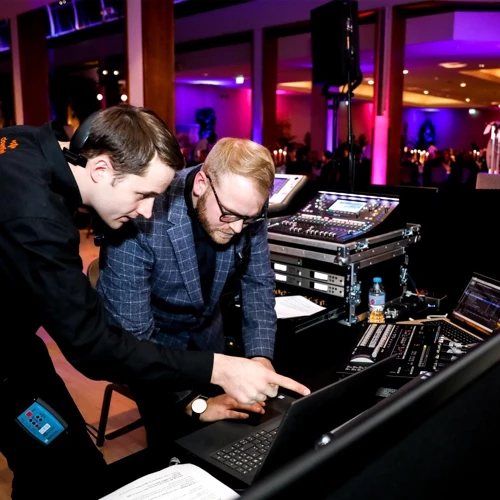
AV should follow the programme. A speaker-led session may need mics, screens, playback and a technician. Check sightlines and speech coverage when the room is occupied, and allow time to test films and live questions.
Our corporate AV production service covers technical planning and operation. Include rehearsal time and operator support in the brief, alongside equipment. Keep one approved presentation master, with clearly identified local sections.
Give remote colleagues a useful way into the programme. A leadership presentation may suit a live stream with moderated questions. A drop-in event may work better with scheduled online conversations or digital contributions. Filming a busy room doesn’t automatically give someone at home a useful experience.
Test participation on company devices and networks. Check that links open and instructions make sense, and give someone responsibility for responding. Where live attendance is impractical, provide another way to contribute or catch up.

What do you need
from each office?
Collect the same site information before approving layouts or transport: usable dimensions, attendance windows, delivery access, lift dimensions, available power and network restrictions. Photos help, but a picture of an empty room will not tell you whether a delivery can reach it.
Agree installation and collection windows, storage and a local facilities contact. Check accessible routes, seating and quieter spaces. If colleagues will still be working nearby, plan how the event shares entrances and circulation routes with the office.
The HSE’s event-management guidance stresses coordination and sharing relevant risk information. Include local facilities teams rather than assuming one site’s arrangements cover the whole tour.
If an office cannot accommodate the format, an external venue may be worth considering. We can help with venue finding, including through our London and South East partner network. Our Venues We Trust page is a starting point for those locations.
Give the programme one central client decision-maker, an agreed delivery lead and a contact at each site. Your company representatives own business-specific conversations. Event hosts can welcome people and guide participation, but should not be expected to answer internal policy questions.
How should you plan
dates and transport?
Build the route around the full delivery schedule, including installation, packing and travel. Event opening times are only part of it. Where dates are flexible, compare routes before sending invitations.
Two consecutive dates may look sensible on a calendar but require separate equipment or crews if the next build begins before the previous event finishes. Include crew working time and accommodation rather than judging the route only by mileage.
Account for your own materials too. Give the delivery team quantities, dimensions and weights for anything you want transported. Agree who collects it, where it is stored and what happens after the final stop.
Label boxes by destination and contents. Make it obvious which materials travel throughout the programme and which stay with a local office. That avoids unpacking the next stop’s supplies halfway through the tour.
Keep one current schedule showing access times, local contacts, build windows and event hours. Agree how requests for extra sessions or different opening times are approved, because they can affect staffing and the next delivery.
Bring the provisional itinerary to your event partner before every date is fixed. Early input gives you room to adjust the route, rather than paying to work around commitments that were made separately.
How much does a
corporate roadshow cost?
The cost depends on the format, number of locations and delivery schedule. Ask for a programme-level proposal that separates shared preparation from the cost of each stop.
Shared preparation can include programme development, artwork and coordination. Each location adds its own build, equipment, crew and operating hours. Larger layouts or extra sessions can change those requirements.
Ask for vehicles, accommodation, material handling and storage between dates to be identifiable. Include digital participation, testing and moderation where required, rather than assuming an online element comes free.
A single-event price multiplied by the number of offices can miss both shared costs and additional logistics. Compare proposals against the same provisional itinerary, audience and operating hours.
Check which charges are fixed, how changes are approved and whether VAT is included. Agree what happens if a date moves, a site drops out or access hours change.
Protect the core experience when reviewing the budget. Reducing decorative variations may be workable. Removing the person responsible for live delivery changes the risk you’re taking.
Use our corporate event management service for wider planning and coordination, or corporate AV production when the programme is already in place and needs technical delivery.
When should branding
and content be approved?
Work backwards from production and testing, not from the first event’s opening time. Involve your event partner once you know the purpose and likely locations, before invitations and printing limit your options.
Different spaces may need different artwork sizes. Approve the overall design and site layouts before preparing final print files, then name one person to sign them off.
Separate physical production deadlines from presentation deadlines. Updating a slide is a different job from replacing a printed backdrop already packed for dispatch.
Confirm actual lead times with your production team. They depend on materials, quantities and the work involved, so one generic deadline will not cover every element.
Before the first stop, check the layout and test anything colleagues will use. Allow time to make changes. A test the evening before departure leaves very little room for a useful discovery.

Where do corporate
roadshows go wrong?
- The largest office sets the whole design. Smaller sites inherit a layout they cannot use properly.
- Dates are fixed before delivery is checked. Tight turnarounds create avoidable staffing or transport costs.
- Local additions bypass approval. The budget and experience change from stop to stop.
- Company materials appear late. The vehicle and storage plan no longer matches what needs moving.
- The programme ends when the team packs away. Questions and promised follow-ups lose their owner.
Review delivery after each stop. If signage confused people or one area became crowded, agree the adjustment before the next visit. Each location should benefit from what you learned at the last.

Our advice: settle the core
before adding extras
- Agree what every colleague should be able to access, and which elements can change to suit each site.
- Name who approves content, spending and local requests, with one clear lead for delivery.
- Check the whole route, including build windows, transport and the materials your own teams need moved.
- Test the physical setup and remote participation before the first stop, with time to make changes.
- Measure attendance against the people who could realistically attend. Check whether they found useful contacts, had questions answered or took the intended next step.
Use the same core measures at every stop, with enough context to compare fairly. Record recurring questions and assign someone to respond afterwards. Our guide to measuring event ROI explains how to connect those measures to the wider business purpose.

What’s included in a
Clownfish roadshow booking?
We agree the scope around your programme and the support your team needs. That can cover creative development, site planning, branded production and logistics, with AV and on-site operation where the format calls for them.
Our corporate event management team can help coordinate the wider programme. We establish what travels between locations, what changes locally and how your own teams connect with the delivery plan.
If you already own the programme, our corporate AV production service can provide the technical planning, equipment and operators your sessions need. The proposal should make those responsibilities clear.
Your team provides the business message, approvals and company representatives. Agree their availability alongside the event schedule so colleagues can reach the right people at each stop.
Venue finding, storage of your materials, remote participation and reporting should be written into the proposal where required. They are not automatic inclusions in every booking.
Agree what happens after the final stop, including the return of materials and ownership of outstanding questions. Read the terms of our satisfaction guarantee alongside your proposed scope.
Corporate roadshow FAQs
What is a corporate roadshow?
A corporate roadshow is a series of events with a shared purpose delivered in different locations. This guide focuses on company programmes for employees, such as leadership visits, onboarding and internal engagement.
Can we run a roadshow in our own offices?
Yes, provided each space suits the audience and planned activity. Review delivery access and day-to-day office use as well as the room itself. Where a site is not suitable, consider a nearby external venue.
Does every office need the same setup?
No. Match the main content and opportunities to participate, then adapt the physical production. Repeated sessions may serve a small office better than trying to fit a large installation into it.
How early should we involve an event company?
Once you know the purpose and likely locations. Early input helps test the itinerary and site requirements before invitations, printing and other commitments limit your options.
Can colleagues working from home participate?
Yes. Depending on the format, that could mean online questions, a scheduled conversation or access to a live session. Decide who will support those colleagues rather than leaving participation to the platform alone.
Who staffs company information stands?
Your own representatives should handle specialist company questions. Agree separately what event hosts will do, such as welcoming visitors, explaining participation and managing queues.
Can our materials travel with the event equipment?
Include that request in the delivery brief. The team needs an inventory and packing details to assess vehicle space, handling and storage before confirming the arrangement.
How do we compare roadshow quotes?
Give suppliers the same provisional itinerary and scope. Compare preparation, each stop’s delivery and the costs between dates. Check exclusions and change terms before comparing headline totals.
What AV do we need for a corporate roadshow?
Base the technical brief on what happens in each room. Presentations may need mics, screens and an operator. Conversation-led sessions may need less. Include testing and rehearsal time, and check how the equipment will work in each location.
How do we measure whether the roadshow worked?
Agree success measures before the first visit. Look at participation in context, useful conversations and the actions people take afterwards. Give recurring questions and promised follow-ups a named owner.

Written by
Ellie Perrett
Account Manager
Ellie joined Clownfish in July 2024, bringing years of events experience and a Hospitality Management degree from Surrey. She believes corporate events should be fun, turning the “same old” into grown-up playgrounds that get adults giggling because when people feel good, everything else is easy.
Outside work, Ellie enjoys cooking, working out and honing her wine-tasting skills. Her favourite Clownfish kit is Mario Kart, and her potato of choice? A beef-dripping triple-cooked chip with peppercorn sauce.
Give every location
a reason to take part
We bring event management and production expertise to company programmes, with the scope shaped around your team. You can read the terms of our satisfaction guarantee before deciding how much to put in our hands. Send us your locations, provisional dates and purpose, and we’ll help turn them into a workable roadshow brief.

