


Interactive entertainment vs live entertainment: which one gets your guests off their phones, and do you really have to choose just one?
Interactive entertainment wins on participation. Live entertainment wins on atmosphere. If you’ve been asked to book “something fun” for your next company event and you’re stuck deciding between a Scalextric track and a live band, that’s the short answer, and it’s rarely a straight either-or once you look at what each one is actually good at.
Clients booking this usually worry about picking the wrong format and watching half the room disappear to the bar by half past eight. We worry about something slightly different: matching the format to the moment, the guest list and the budget, because that match is what decides whether people are still talking about your event in January or have already forgotten it by the following Monday.
The short version: interactive entertainment (hosted games, competitive socialising, photo experiences) gets more guests actively involved and tends to win on raw engagement, especially for large, mixed groups who don’t already know each other well. Live entertainment (bands, DJs, magicians, staged acts) builds the atmosphere and prestige a formal moment needs, and it wins when the room is there to watch and listen rather than compete. Most events over 100 guests do best with a deliberate mix of both rather than an all-or-nothing choice, and neither format is automatically the cheaper one. Interactive packages start from £3,495 excluding VAT, individual live acts from £1,295.
Where the Wrong Entertainment Choice Falls Flat, and Where the Right One Lands
Before the definitions and the numbers, it’s worth seeing what the gap between a good booking and a mismatched one looks like from the guest’s side of the room, because that’s what people actually remember.
| Where the wrong format falls flat | Where the right format lands |
|---|---|
| A live band plays to a crowd that was never going to dance, and the dancefloor stays empty. | Live entertainment scheduled for the moment the room is ready to let go. |
| Interactive games sit in a corner nobody notices because there’s no host pulling people over. | A hosted activity that actively invites guests in rather than waiting for them. |
| A formal awards presentation gets talked over because there’s nothing to focus the room’s attention. | A staged, mic’d moment that gives a formal announcement the weight it needs. |
| Guests spend the evening standing in small, familiar groups because nothing forces them to mix. | A competitive game that puts strangers on the same team within minutes. |
The gap between those two columns isn’t really about which entertainment type you picked. It comes down to whether someone thought about what each part of your evening actually needs from the room, and whether the team running it has a host in place to make it happen rather than just dropping off a game and hoping.
What Is the Difference Between
Interactive and Live Entertainment?
Interactive entertainment requires guests to actively participate, while live entertainment is primarily performed for an audience. Interactive entertainment includes games, challenges, simulators and hosted activities that encourage networking and engagement. Live entertainment includes musicians, bands, DJs, magicians and performers who create atmosphere and entertainment through performance.
For most corporate events, the best results come from combining both formats to create energy, participation and memorable experiences.
| Feature | Interactive Entertainment | Live Entertainment |
|---|---|---|
| Guest Participation | High | Low |
| Networking Potential | High | Medium |
| Energy Level | High | Medium |
| Best For | Team Building & Networking | Atmosphere & Performances |
| Competitive Element | Yes | No |
| Audience Involvement | Direct | Indirect |
| Suitable For Large Events | Excellent | Good |
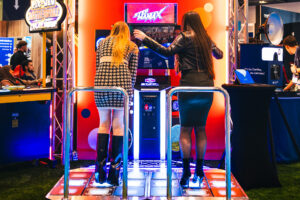
Interactive entertainment is anything where the guest is the one performing. Think retro arcade games, giant Scalextric tracks, VR experiences, photo booths and competitive socialising formats built for teams to play against each other. A host runs the activity, but the guest is doing the thing that makes it fun.
Which Entertainment Works Best
for Different Corporate Events?
Conferences:
Conferences can benefit from a combination of interactive and live entertainment. Interactive activities can give delegates something to do during networking breaks, while live performers can help create atmosphere between sessions. The right choice depends on the size of the conference, audience and overall event objectives.
Awards Ceremonies:
Awards ceremonies are ideal for live entertainment that creates atmosphere and gives the evening a sense of occasion. Live musicians, performers or a DJ can help maintain energy between awards and during the evening reception. Interactive entertainment can also be added to encourage guests to socialise once the formal part of the event has finished.
Corporate Christmas Parties:
Corporate Christmas parties are a great opportunity to combine interactive and live entertainment. Interactive games and experiences can get colleagues involved and encourage networking, while DJs, live music and performers can create the party atmosphere. Combining both gives guests opportunities to participate as well as simply enjoy the entertainment.
Summer Parties:
Summer parties often provide more space and flexibility for interactive entertainment. Outdoor games, challenges and immersive experiences can encourage guests to get involved, while live music and DJs can create the atmosphere as the event moves into the evening. For larger company summer parties, a combination of both can keep guests entertained throughout the event.
Product Launches:
Product launches need entertainment that supports the brand and gives guests something memorable to experience. Interactive entertainment can encourage participation and create opportunities for guests to engage with the brand, while live performers can help create excitement around key moments of the launch.
How Much Does Corporate
Event Entertainment Cost?
Live entertainment is the opposite arrangement. A band, DJ, magician, singer or staged performer does the entertaining, and the guest’s job is to watch, listen or dance along. It’s the format most people picture first when they hear “corporate entertainment,” and it’s the one built around a stage, a set list or a routine rather than a rulebook.
The practical differences come down to who’s doing the performing, and that changes almost everything else about how you plan around it:
| Factor | Interactive entertainment | Live entertainment |
|---|---|---|
| Who performs | The guest | The act |
| Best guest role | Playing, competing, taking part | Watching, listening, dancing |
| Typically suits | Large, mixed or cross-team groups | Formal moments, celebrations, milestone nights |
| Price from (excl. VAT) | £495 (single game) to £9,985 (full package) | £1,295 (magician, DJ) to £4,500+ (full live act) |
| Space needed | A dedicated footprint per activity | A stage or performance area, plus PA |
| Hosting | Always hosted by a Clownfish team member | Self-contained, though briefing the act on the room still matters |
| What it generates | Photos, video and social content of guests themselves | Atmosphere, a shared focal point, a sense of occasion |
Neither list is a ranking. A conference evening reception and a black-tie awards dinner need almost opposite things from their entertainment, which is exactly why “which is better” is the wrong question to start with.
Which Delivers More Engagement,
Interactive or Live?
On raw participation, interactive entertainment usually wins, and the reason is simple: a guest can’t half-watch a game they’re playing the way they can half-watch a band from across the room. That matters commercially, not just for atmosphere. A guest who’s actively competing is a guest who isn’t checking their phone, isn’t hovering near the exit, and is far more likely to be the one posting a photo or video that puts your event in front of people who weren’t even there.
Event Marketer’s EventTrack research found that 91% of consumers say taking part in an event or experience makes them more inclined to buy from that brand afterwards, and that a live, participatory experience is consistently more memorable than watching one unfold. That’s brand marketing data, but the underlying point holds just as well for an internal company event. People remember what they did, far more clearly than what they watched.
Live entertainment still earns real engagement, just a different kind. A packed dancefloor, a room that goes quiet for a magician’s reveal or applauds a live band’s closing number is genuine engagement, it’s simply concentrated into a few big shared moments rather than spread evenly across the whole evening. Where interactive activities keep 50 small conversations going at once, a strong live act can make 300 people feel one thing at the same time. Both are worth having. They’re just not measuring the same kind of attention.

When Does Live Entertainment Win,
and When Does Interactive Win?
An awards ceremony or a formal gala dinner is live entertainment’s territory. The room is there for a structured programme, speeches, a presentation, applause at the right moments, and interactive games would fight for attention against exactly the thing the evening is built around. A live band or a professional MC gives that structure the weight it needs, and it’s why we handle so much of our awards ceremony production work with staged AV and a live act rather than a games line-up.
A large summer party or a cross-departmental networking event is the opposite case. Put 300 guests from different teams in a room with only a live band, and the people who already know each other will cluster together while everyone else stands at the edges. Interactive entertainment forces the mix. A team-based game puts strangers on the same side within minutes, which is exactly why it’s the backbone of most of our team building work as well as our summer party bookings.
A conference sits somewhere in between, and the answer changes by moment rather than by event. Networking breaks favour something interactive and low-commitment, a magician working tables, a quick head-to-head game, because delegates are there to talk business, not watch a show. The evening reception afterwards can carry more live entertainment once the working day is done and the room is ready to switch off. A product launch depends entirely on what the brand needs the moment to say: a big reveal usually wants a live, staged element, while the after-party that follows it often works harder with an interactive centrepiece guests can actually get their hands on.

Which Option Delivers Better
ROI for a Corporate Event?
Neither format has a fixed ROI advantage. What decides it is cost per guest actually engaged, not the headline price on the quote. A single hosted game running all night at £925 can occupy a rotating queue of 150 guests over the course of an evening, which works out to a few pounds per guest served. A live band at £3,495 might be the single biggest line item on the invoice and still be the better spend, because the atmosphere it creates is the thing your CEO and the room remember, and that’s not a cost you can fairly measure per head.
Entertainment as a whole usually sits at 15 to 25% of a total event budget, smaller than venue or catering. Don’t read that percentage as permission to treat it as the easy place to cut. Venue and catering set the room up. Entertainment is what decides whether anyone’s still talking about the event a week later, and pound for pound it’s usually the cheapest layer of the budget relative to the difference it makes.
If you’re weighing this up against a hard number to defend to finance, the practical answer is to price both properly rather than defaulting to whichever one sounds cheaper on paper. A DJ from £1,295 and a single interactive game from £925 can sit in the same budget bracket and do very different jobs. Ask what you actually need the room doing at each point in the evening, then price against that, not against a generic “entertainment” line.
Can Interactive and Live
Entertainment Work Together?
Yes, and for most events over 100 guests, it’s the format we’d actually recommend. The two aren’t competing for the same slot in the evening if you plan them that way on purpose. Interactive games during arrival and drinks give guests something to do the moment they walk in, before anyone’s had a chance to feel awkward standing alone with a glass of wine. A live act, whether that’s a band building into a set or a DJ taking over once the formal part of the evening wraps up, then carries the room through to the point where people actually want to dance.
The trip-up isn’t the idea, it’s the logistics. Two schedules, two hosts and two sets of kit that have never worked together before is how you end up with a magician trying to perform over a live band’s soundcheck, or a games zone that’s still running when the MC is trying to bring the room’s attention to the stage. That’s really a Delivery problem more than an entertainment one, and it’s the reason we run both formats from the same warehouse and the same operations team rather than subcontracting either one out. One team, one running order, one point of contact who knows exactly when the games pack down and the band plugs in.

Where Choosing the Wrong
Format Quietly Falls Short
- Booking a live band for a young, casual team and expecting an early dancefloor. Live music builds slowly. If your crowd needs something to do from minute one, interactive games close that gap far faster.
- Filling an entire evening with games and leaving nothing for the room to focus on together. Even a highly interactive night benefits from one shared moment, a live act, a toast, an announcement, that pulls everyone’s attention to the same place.
- Assuming interactive automatically means cheaper. A single custom-built activity with bespoke branding can cost more than a straightforward live act. Price against what you need, not against the format’s reputation.
- Treating a live act as background music rather than briefing them properly. A band or DJ who knows your running order, your audience and the moment they’re walking into will read the room far better than one who’s simply told to “play until 11.”
- Skipping a proper sound check because the entertainment is “just live music.” Poor audio at a formal moment, a toast, an award announcement, a keynote, does more damage to the evening than almost anything else on this list.

Our Advice for Choosing Between
Interactive and Live Entertainment
Work out what you want guests doing at each stage of the evening, not what entertainment “type” you want overall. Arrivals, main event, wind-down each have a different job to do.
Size the format to the room, not just the headcount. A 40-person client dinner and a 400-person summer party need very different energy even at a similar per-guest spend.
Don’t assume live is automatically more prestigious, or interactive automatically more casual. A beautifully staged live act can feel just as premium as a bespoke branded game, and a poorly run version of either feels cheap.
Ask any supplier how the two formats would run together, even if you’re only booking one for now. Their answer tells you how much thought they’ve actually put into the room, not just the booking.
Book earlier for summer party season and December. Both are when the widest choice of live acts and interactive hosts disappears fastest.

What’s Included in an Interactive or
Live Entertainment Booking
We’ve been running both interactive and live entertainment for corporate events in London since 2009, which means we’ve built the games and booked the acts for just about every format there is: client days, conferences, product launches, awards nights and summer parties among them. Our 50-person full-time team works from our own four warehouses of equipment, so whether you book a Scalextric track or a live band, nothing you get is borrowed or subcontracted out. We deliver, install, host and pack down every booking ourselves, and if you’re combining formats, the same operations team runs the whole schedule rather than juggling two separate suppliers.
We’re also the only company in the industry offering a genuine money-back guarantee. If the entertainment doesn’t engage your guests, if equipment fails, or if a host underdelivers, you don’t pay for it, whichever format you booked.
Fiona Litchfield, Executive Assistant at StoneX, put it like this after we ran their summer party for 500 guests:
“Thank you so much for all your amazing work to make our summer party a wonderful success. The atmosphere was relaxed and just right.”
Clownfish Events has been delivering corporate event entertainment, event management and AV production across London since 2009. With four warehouses of equipment and an in-house team of event specialists, we have helped hundreds of organisations create memorable conferences, awards ceremonies, product launches, summer parties and corporate Christmas events. We’ve earned 347 five-star reviews on Reviews.co.uk, delivering interactive and live entertainment for companies including Google, Amazon, Netflix, Spotify, Atlassian and Lloyds. Read the guarantee in full, browse every format and its price on our event entertainment hire page, or see how both formats come together in practice in our case studies.

Frequently asked questions
What is interactive entertainment?
It covers anything your guests actually operate or compete in themselves. Arcade games, giant garden games, VR simulators, competitive team challenges and photo experiences are the most common examples. A Clownfish host always runs the activity and pulls guests in, but the entertainment comes from what your guests are doing, not from watching a performer do it for them.
Is live entertainment better than interactive experiences?
Neither is better across the board. Live entertainment builds atmosphere and suits structured, formal moments, while interactive experiences drive higher hands-on participation, particularly with large or mixed groups. Which one is “better” depends entirely on what a specific part of your event needs the room to be doing.
Which option generates more engagement?
Interactive entertainment usually keeps more guests occupied for more of the evening, since there’s almost always a queue or a rotation running. Live entertainment creates fewer, bigger peaks instead, the room going quiet for a magician’s reveal or filling the dancefloor once a band gets going. The right choice depends on which kind of attention that evening actually needs, spread out and constant, or occasional and intense.
Which option delivers better ROI?
There’s no fixed winner. Weigh up what each pound actually buys. An interactive activity often keeps far more guests busy for the money, while a live act can earn its price by creating the one moment that defines how people describe your event afterwards. Price both against the specific job you need them to do that evening, rather than assuming either format is automatically the smarter spend.
How do themed events improve engagement?
It gives guests something to do beyond stand near the bar: somewhere to take a photo, a reason to wander over to a colleague they wouldn’t normally approach. Matched with games and entertainment that reinforce the same theme, it turns a passive evening into one guests actually take part in, which is usually the difference between a party that’s forgotten by New Year and one that isn’t.
Can both formats work together?
Yes, and combining them works best when one supplier runs the whole schedule rather than two separate ones. The real risk with mixing formats isn’t the idea, it’s timing, a live act’s soundcheck clashing with a games zone, or an activity still running when a host is trying to bring the room’s attention to the stage. Book both from a team with one running order, and that risk mostly disappears.
What is live entertainment for a corporate event?
Live entertainment covers any act that performs for your guests rather than involves them directly, bands, DJs, magicians, singers, mind readers and staged performers. It’s built around a set, a routine or a running order rather than a rulebook, which is what makes it suit formal or celebratory moments so well.
How much does interactive entertainment cost compared to live entertainment?
Individual interactive games start from around £495 to £2,995 depending on the activity, with full hosted packages from £3,495 excluding VAT. Live acts start from £1,295 for a DJ or magician, rising to £4,500 or more for a larger live band. Neither format is reliably cheaper than the other, since the total depends far more on guest numbers and how much of the evening you’re covering than on which format you pick.
What size event suits interactive entertainment best?
Interactive entertainment scales well from a 20-guest client day right up to a 500-plus guest summer party, and it’s particularly strong for larger, mixed groups where guests don’t already know each other well, since a hosted game gets strangers talking within minutes.
Do we need more space for live entertainment or interactive games?
It depends on the specific act or activity rather than the format itself. A DJ needs a stage and a PA in a fixed spot, while a single interactive game needs its own dedicated footprint that can’t be walked around easily. Running several interactive activities alongside each other generally asks for more total floor space than one live act in a corner of the room.
How far in advance should we book entertainment for a corporate event?
As early as you can once your date is confirmed, ideally three to six months out for either format. Summer party season and December both see the widest choice of live acts and interactive hosts booked up first, so waiting narrows your options and can push up your price.

Written by
Ellie Perrett
Account Manager
Ellie joined Clownfish in July 2024, bringing years of events experience and a Hospitality Management degree from Surrey. She believes corporate events should be fun, turning the “same old” into grown-up playgrounds that get adults giggling because when people feel good, everything else is easy.
Outside work, Ellie enjoys cooking, working out and honing her wine-tasting skills. Her favourite Clownfish kit is Mario Kart, and her potato of choice? A beef-dripping triple-cooked chip with peppercorn sauce.
Ready to get a quote for your own event?
We’ve been running both interactive and live entertainment for corporate events in London since 2009, working from our own equipment across a 50-person full-time team with no subcontracted freelancers in the chain. That record is backed by 347 five-star reviews, the only no-quibble money-back guarantee in the industry, and trust from clients including Google, Amazon, Netflix, Spotify, Atlassian and Lloyds. Browse the full range of formats and prices on our event entertainment hire page, or get in touch and we’ll help you work out the right mix of interactive and live entertainment for your own guest list, with more planning guidance available in our Knowledge Centre.

